Environmental management and approvals
EPBC Approval received
The Hopeland solar and BESS project was approved by the Department of Climate Change, Energy, the Environment and Water (DCCEEW) in May 2026. Our team will meet the conditions of approval during the course of the project’s construction and operation.
EPBC Stage 1 referral history
The EPBC Act and regulations are Australia’s main national environmental legislation. They provide a way to protect and manage nationally and internationally important plants, animals, habitats and places.
In October 2023, we referred the project to the federal Department of Climate Change, Energy, the Environment and Water (DCCEEW) based on potential impact on habitat for threatened fauna species – which while not found during surveys, still need to be considered as potential habitat was present.
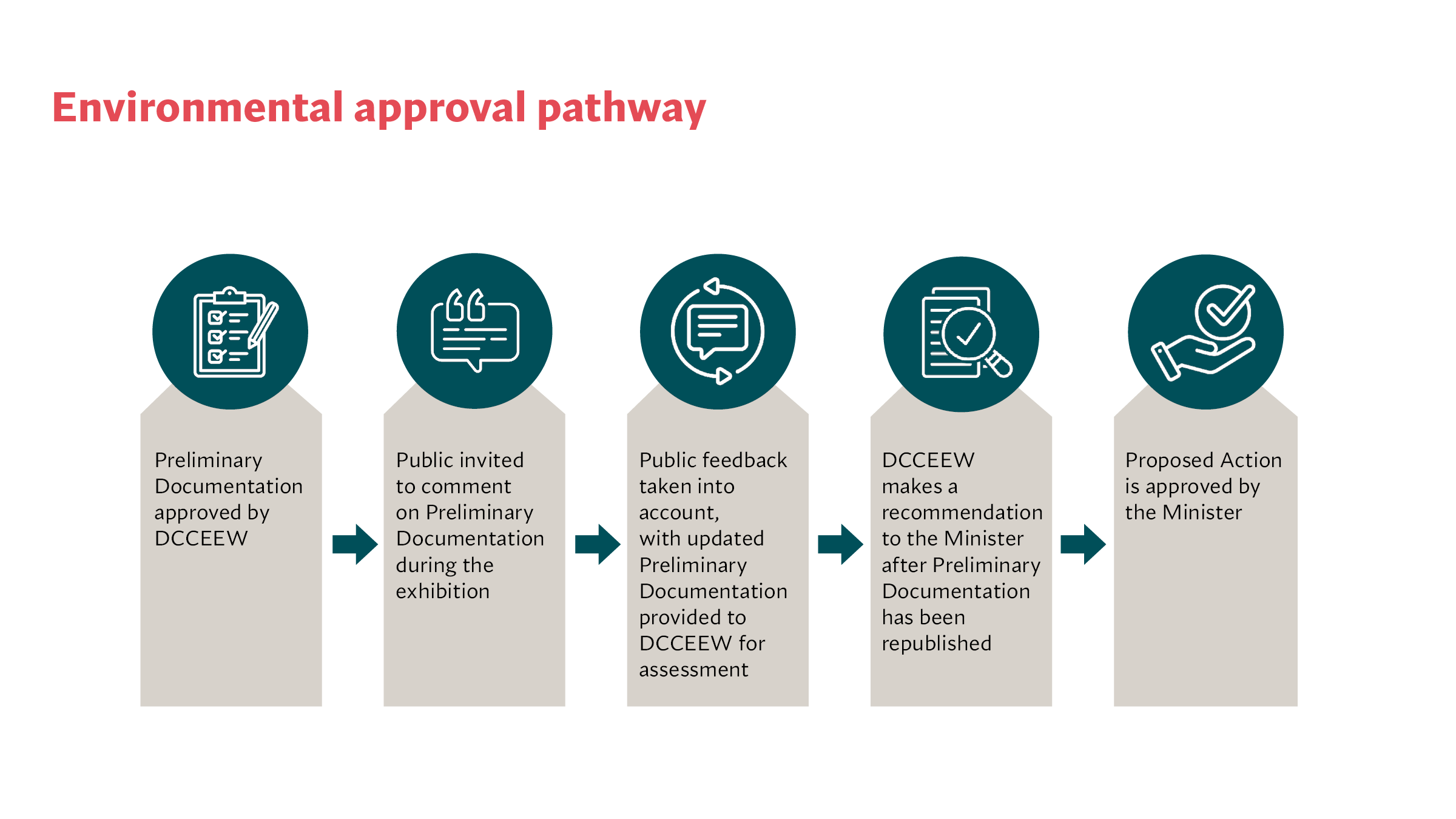
The referral was made available for public comment in January 2024. A decision notice was received in February 2024, confirming that the Project will be a Controlled Action, with an assessment pathway via Preliminary Documentation (see stage 2 in the figure below).
This assessment method is selected when project impacts are short- and medium-term, or recoverable, and DCCEEW requires more information about mitigation or offset strategies.
You can see the Stage 1 Decision on the EPBC referral portal here: Referral summary - EPBC Act Public Portal. Please use this referral number: 2023/09684.
EPBC Stage 2 approval pathway history
The Project was varied on 26 June 2025 to include a transmission line connection under the same referral as the solar farm, to be included in this Preliminary Documentation. The Federal Delegate to the Minister of Environment approved the variation with Section 156 of the EPBC Act.
On 22 January 2026, DCCEEW deemed the draft Preliminary Documentation as satisfactory, and the Federal Delegate to the Minister for Environment approved it for public comment. The documentation was made available for public comment between Tuesday 27 January until Tuesday 10 February 2026.
We received one submission and updated the Preliminary Documentation accordingly. The main changes were in the Offset Proposal and the Offset Management Plan located in Volume Two and Volume Three. You can read the documents at the links below:
Hopeland Solar PD - Volume 2, Append A to I
Hopeland Solar PD - Volume 3, Append J to Q
Note: to view landscape pages, download the document, open the PDF and rotate the pages.
Persons with special needs (e.g. for whom English is a second language or who have a vision impairment) may contact the Pacific Partnerships Hotline at +61 7 3543 3212 for assistance in accessing the material.
Environmental commitment
Hopeland Solar Farm is committed to avoiding and minimising environmental impacts where possible, as part of the project’s sustainable development. Ecological surveys across the project area and connection to Western Downs Substation were completed between 2023–2025. The purpose of the surveys was the identification of ecological values and Matters of National Environmental Significance (MENS) species to inform the environmental approvals.
Within the Project Area, 65% (472 ha) is regrowth native vegetation, 19% (139 ha) is remnant native vegetation, and 16% (118 ha) is cleared agricultural land with negligible regrowth. Most native vegetation occurs in the south, with Brigalow and Eucalypt threatened communities in the north and east. Dominant species include Poplar Box, Gum-topped Box, Ironbark, and Brigalow.
Addressing impacts
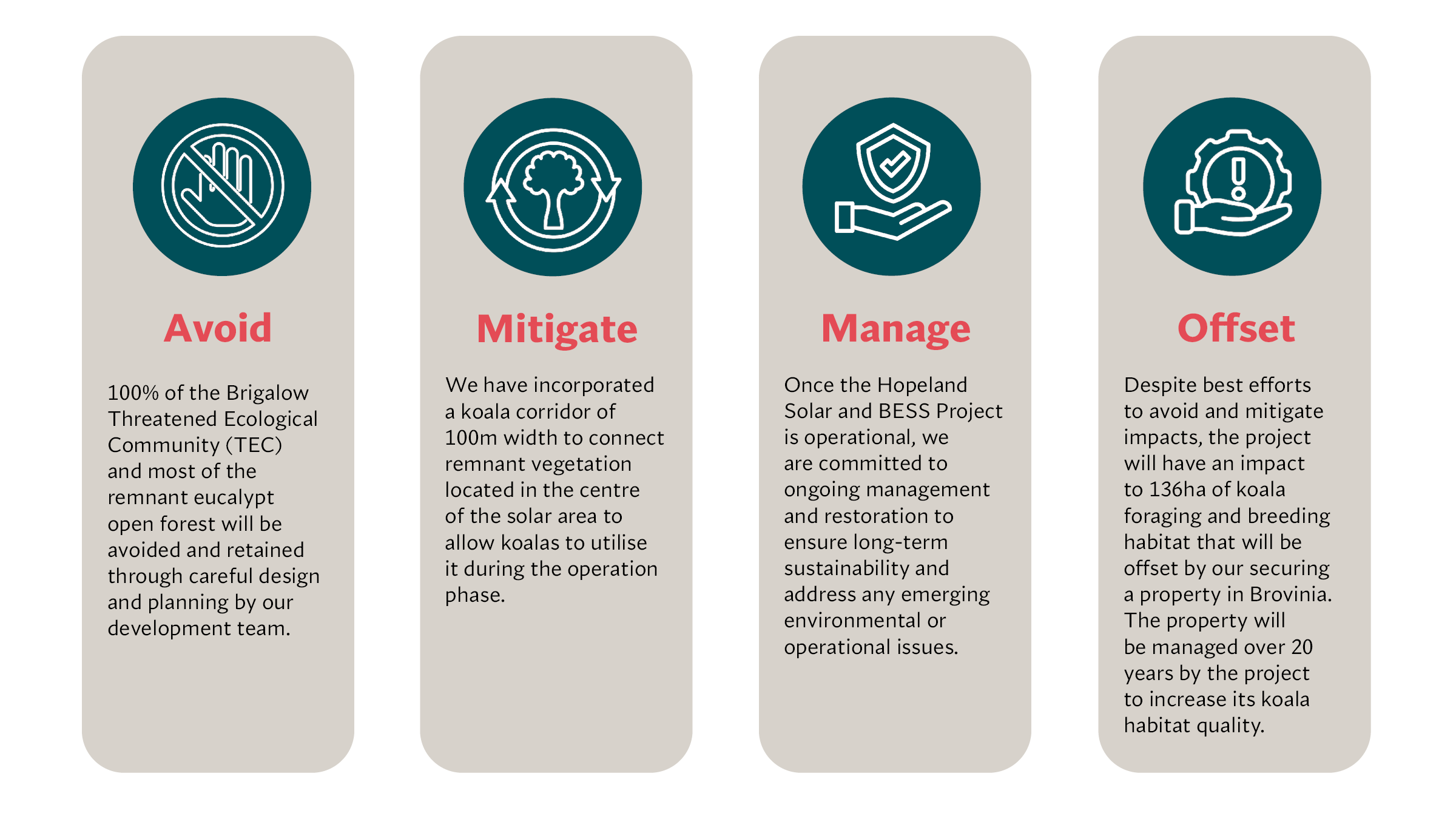
In line with best-practice management, a range of environmental plans and controls will be implemented to avoid, mitigate, manage and offset impact.